Monitoring
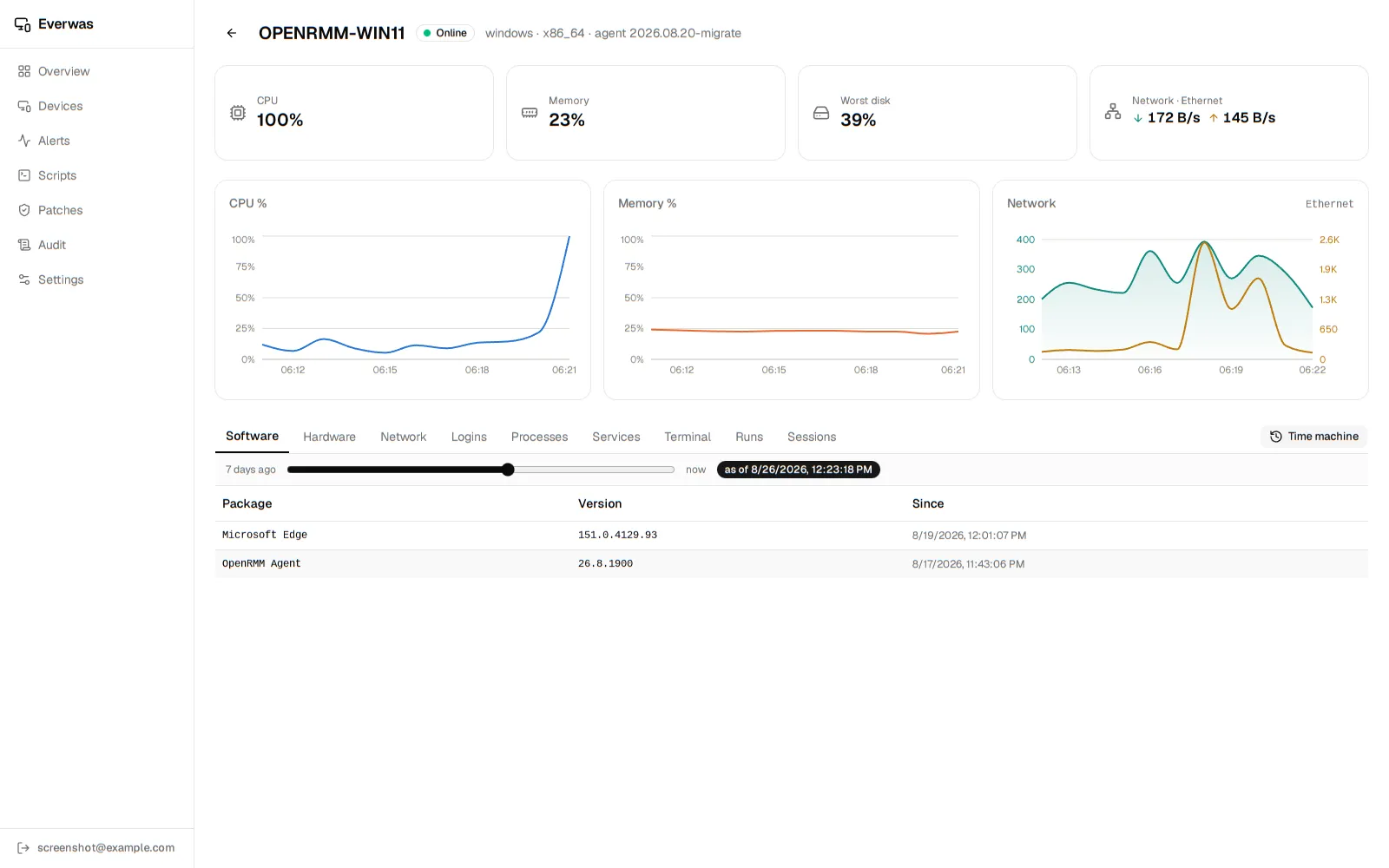
Heartbeats plus CPU, memory, disk, and network telemetry from every endpoint, charted live in the dashboard.
Open source · AGPL server · Apache agent
Everwas manages Windows, macOS, and Linux fleets: telemetry, alerting, a real terminal in your browser, scripts, and patching. And it keeps device history on two time axes, so it can answer what was true on a machine and what you believed at the time.
$ everwas-agent install --token ew_5f2…
✓ enrolled as web-01 (linux/amd64)
✓ service installed: systemd
✓ connected: wss://rmm.example.com (outbound only)

$ everwas fleet status
NAME        OS       CPU   MEM   DISK  SEEN
web-01      linux    12%   38%   61%   now
mac-studio  macos     4%   52%   47%   2s
win-lab-3   windows  77%   81%   92%   1s  ▲ disk
$
What works today
One static Go binary on each endpoint, one server you control. No per-seat pricing, no phoning home, no black boxes between you and your machines.
Heartbeats plus CPU, memory, disk, and network telemetry from every endpoint, charted live in the dashboard.
Threshold rules with duration windows and cooldowns, heartbeat-miss detection, delivery to email, webhook, ntfy, and gotify with retries.
A real PTY on any enrolled machine, opened from the dashboard. Every session is recorded as an asciicast you can replay.
A script library, fleet-wide runs, and cron schedules. Jobs queue durably, so a script sent to a sleeping laptop runs when it wakes.
Hardware, installed software, processes, and services, with full history you can rewind to any point in time.
Scan, approve, deploy across apt, dnf, pacman, Windows Update, and macOS softwareupdate from one queue.
Signed updates with automatic rollback if the new binary fails to check in. Service install for systemd, launchd, and Windows SCM.
Shell recordings, script runs, patch approvals, and every MCP call land in an audit log written under the identity that acted.
A built-in CA issues and renews each device’s 802.1X certificate over the channel the agent already holds. Renewal pulls, so a laptop that slept through a rotation wakes up and fixes itself.
Firewall, disk encryption, antivirus, and friends. Each check lands as its own bitemporal fact, so “was the firewall on during the incident” is a query, not a guess.
A read-only surface for external systems of record: sweep the whole fleet in pages, or ask the change feed what the server learned, and unlearned, since any point in time.
The console
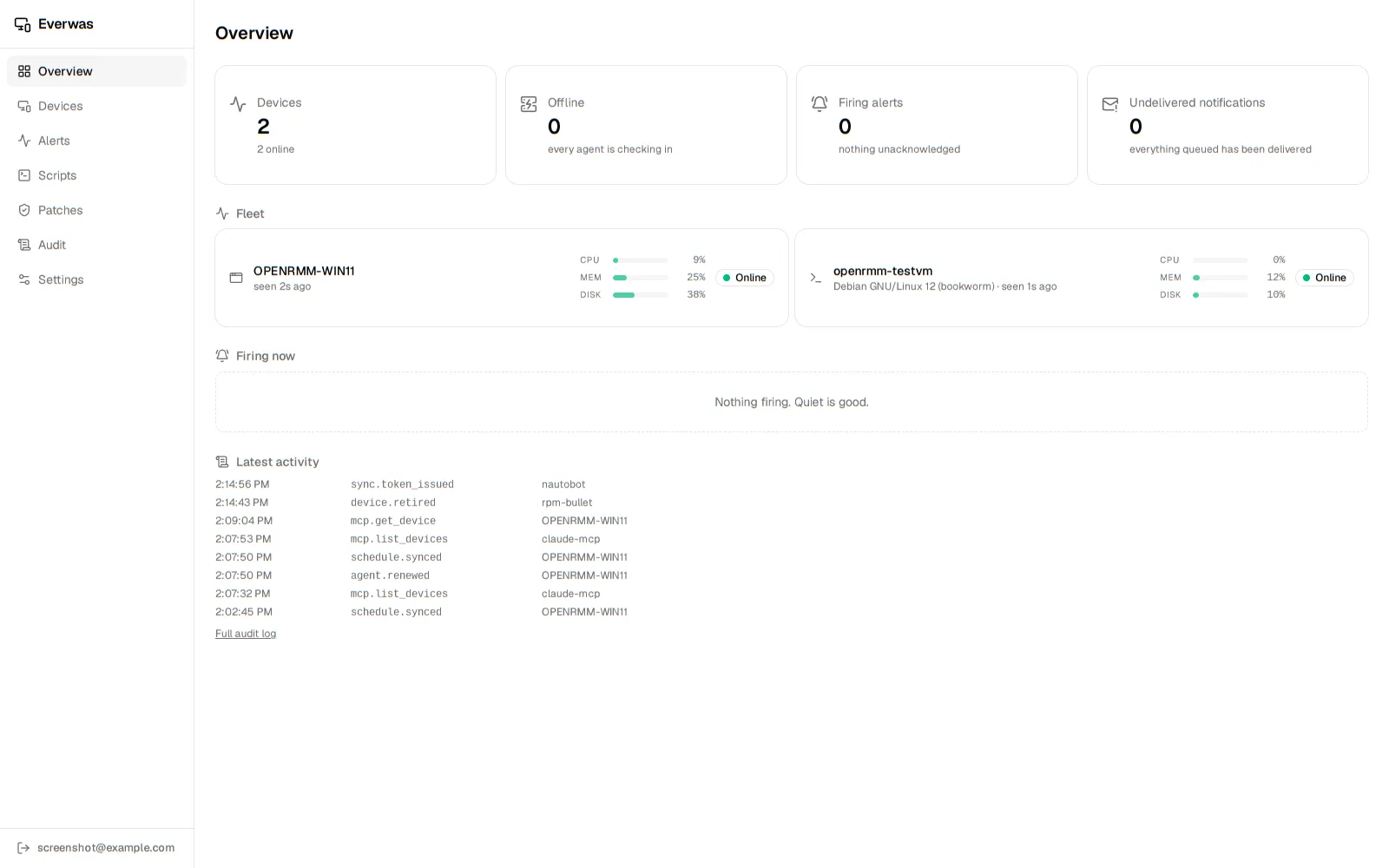
This is the real dashboard on the real dev fleet, not a mockup: live utilization per machine, alerts if there were any, and an activity feed that is the audit log itself. When it says quiet, it means quiet.
Bitemporal inventory
Most tools store one timestamp and quietly overwrite the past. Everwas records when a fact was true on the machine and when the server learned about it. They differ whenever an agent reports late, which is exactly the case that matters after an incident.
"Was web-01 patched during Wednesday's incident?"
GET /devices/web-01/facts?as_of=wed-14:00Yes. Installed Tuesday 09:14. That was the truth on the wire.
"Did we know it was patched when we triaged?"
GET /devices/web-01/facts?knew_at=wed-14:00No. The server still believed the old version. Your Wednesday decisions make sense now.
First-class MCP server
Everwas ships an MCP server, so an AI assistant can ask real questions about your machines, including history on both time axes, and help act on the answers without ever holding the keys itself.
Querying the fleet needs no special grants. Anything that changes a machine takes an explicit confirm and returns a dry-run plan without one.
Each key carries its own scopes. An assistant that can read inventory cannot run scripts unless you decided it can.
Successful or refused, every MCP call lands in the audit log under the key that made it. Assume someone will read it, because they will.
Which machines still have OpenSSL older than 3.0.12?
list_devices · get_device_facts
3 of 41: web-01, win-lab-3, mac-mini-2. web-01 was patched but hasn't reported since Tuesday, per record time it's still on the old build.
Queue the patch on the other two for tonight.
approve_patches confirm=false
Plan, nothing ran yet
approve openssl-3.0.12 on 2 devices · window 02:00–04:00
Nautobot integration
nautobot-ssot-everwas is a first-party SSoT app that syncs what the agents report into Nautobot: endpoints, interfaces, installed software, patch state, and per-check security posture. It reads the same sync API any other system of record would.
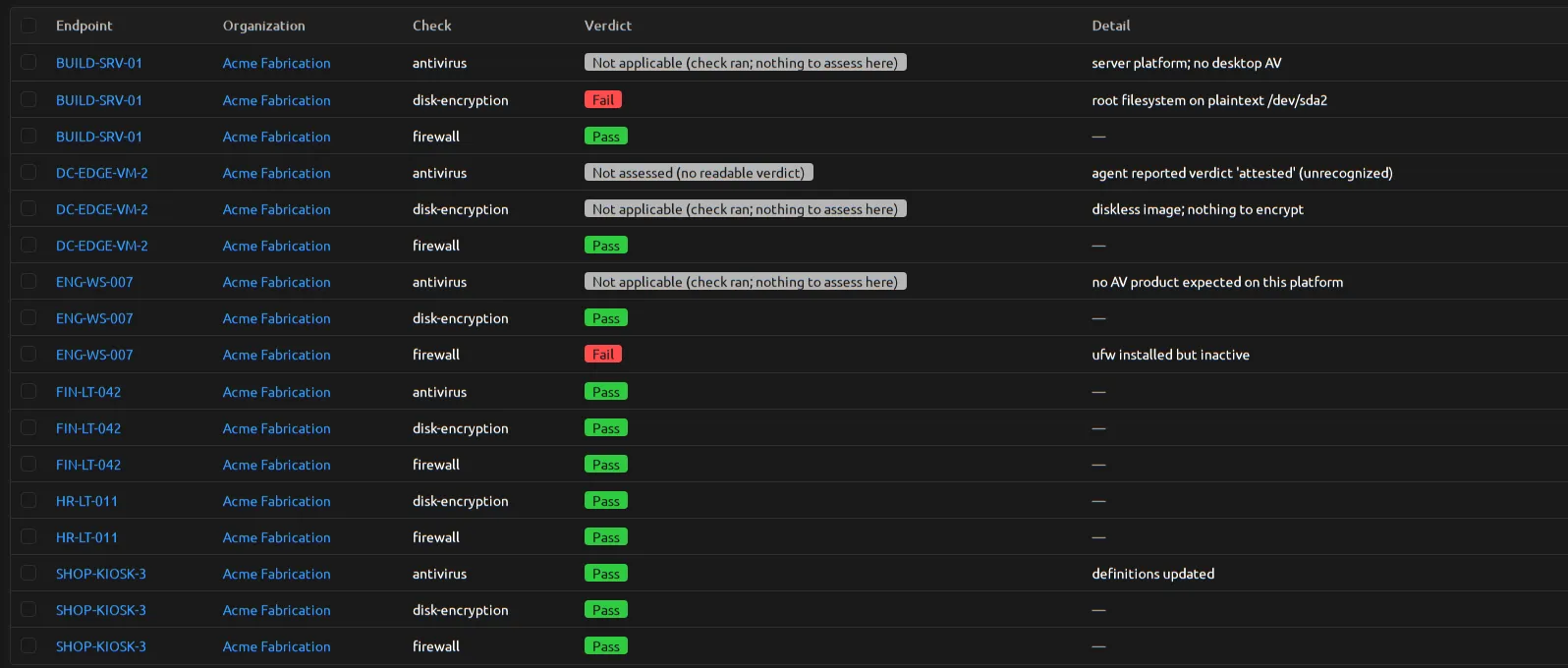
Every synced fact carries both of its timestamps: when it was true on the machine, and when the server learned it. Nautobot inherits the memory, not a snapshot of it.
The sync is idempotent. It diffs against what Nautobot already holds and applies only the difference, so a second run right after the first finds an empty diff and says so.
An endpoint can be promoted to a full Device with its interfaces, and Prefixes and IP addresses derive from the CIDR addresses agents report. Inventory becomes infrastructure records without retyping anything.
The bigger picture
Everwas is not trying to be your source of truth. It is one member of a family of systems that report into Nautobot: Everwas covers the machines, a sibling covers the wire, and the source of truth reconciles both against what you intended.
Everwas and l2trace never talk to each other directly. One reports what is true on machines, the other observes what is true between them, and Nautobot reconciles both against intent.
Everwas facts, l2trace observations, and the belief log they sync into all carry both time axes, so "what did we believe last Tuesday" survives every hop.
Findings land as review-gated proposals. A human applies them; the Everwas sync writes only into its own vendor-neutral models. Nothing observed silently becomes something intended.
Architecture
A Go agent, NATS for transport, FastAPI and PostgreSQL on the server. Pieces you already know how to run, arranged so the endpoints never have to be reachable.
A NATS auth callout issues each agent its own credentials with pinned subject permissions. No agent can see another agent’s traffic, and revoking one is a database update.
Jobs queue in JetStream until the target machine is reachable. A script sent to a sleeping laptop runs when it wakes, not never.
Agents dial out over wss:// on 443 through Caddy. Nothing listens on the endpoint, so it works behind NAT, firewalls, and hotel Wi-Fi.
Quick start
Docker, uv, Go 1.22+, and Node 20+ on the server box. The agent side is a single binary and an enrollment token.
git clone https://github.com/everwas/everwas && cd everwas
cp .env.example .env
cd server && uv run everwas gen-nats-keys   # paste both values into .env
cd .. && make dev
make migrate
make admin EMAIL=you@example.commake enroll-token # prints ew_...
cd agent && go build -o bin/everwas-agent ./cmd/everwas-agent
sudo ./bin/everwas-agent install \
--server https://rmm.example.com --token ew_...Licensing
The commercial RMMs are excellent and expensive. The open-source ones are either monitoring-only or carry licenses that stop you building on them. Everwas picks a lane and stays in it.
Run it, modify it, offer it as a service. If you improve it and host it for others, those improvements come back. That's the deal, and it's a good one.
Permissive on purpose: the binary that runs on customer machines should be auditable, embeddable, and redistributable without a lawyer in the loop.
Sign-off, not CLA. Your contribution stays yours, the project stays open, and nobody can relicense the commons out from under you.
Two licenses is a deliberate design, not indecision.Read the full reasoning